
An Amazon product launch strategy is the sequence of pricing, keyword targeting, advertising, and review-generation decisions a seller makes in the first 30 to 90 days after a listing goes live.
Fifty-seven percent of U.S. consumers begin their shopping searches on Amazon, not Google, which is why a new ASIN’s first few weeks matter more than almost any other stretch of its life on the platform.
Sellers who lean entirely on Sponsored Products often burn through budget without ever earning the organic rank that survives once ad spend stops.
This guide breaks the Amazon product launch strategy down into the exact questions sellers ask before going live: what the strategy actually is, how organic ranking compares with a PPC-only approach, the week-by-week playbook, and how Amazon Vine and Sponsored Products fit around organic rank. At Sellico, this playbook reflects patterns pulled from more than 9,850 completed launches.
What does an Amazon product launch strategy entail?
An Amazon product launch strategy entails sequencing pricing, keyword targeting, paid advertising, and review generation across a new listing’s first weeks in order to reach sustainable organic rank rather than rank that depends entirely on ad spend.
A launch strategy is not a single tactic. It is a schedule.
Pricing usually starts below the long-term target to encourage early purchases, a small set of priority keywords gets targeted through both organic listing optimization and Sponsored Products, and review velocity gets built through compliant channels like Amazon Vine or verified purchase programs.
Each piece reinforces the others: purchases drive keyword indexing, indexing drives organic visibility, and visibility reduces how much a seller needs to spend on ads to stay on page one.
How to launch a new product on Amazon in 2026
Launching a new product on Amazon in 2026 works best as a phased plan across eight to twelve weeks: pre-launch preparation, a velocity push across the first 30 days, then a scaling phase through day 90 that shifts weight from paid to organic.
Pre-launch (four to six weeks out)
Finalize keyword research, optimize the title, bullets, images, and backend search terms, confirm Brand Registry status, set launch pricing, and stock at least 90 days of FBA inventory. Sort keywords into three tiers, Tier 1 anchor terms, Tier 2 supporting terms, and Tier 3 long-tail terms, and plan to spend early budget on Tier 2 and Tier 3, since competing for Tier 1 volume before a listing has any sales history usually wastes money.
Days 1 to 30: building velocity
Open at a discounted price and run a tiered Sponsored Products structure (auto, phrase-match, exact-match), paired with an organic purchase program such as Sellico’s White-Hat Accelerator to build indexing without depending on ads alone. Request reviews through Amazon’s built-in tool and enroll in Vine if eligible, aiming for 15-plus reviews at a 4.0-star average before scaling ad spend further.
Days 31 to 90: scaling
Shift budget toward keywords that are already indexing well, taper the organic program as native sales take over, and let TACoS trend down as organic rank does more of the work. A launch is generally on track by day 90 with page-one rank on at least one priority keyword, 25-plus reviews at a 4.3-star average, and TACoS meaningfully lower than its day-30 level.
How Sellico helps your Amazon launch
White Hat Amazon Accelerator
Sellico’s White Hat Amazon Accelerator service generates real purchase activity around specific keywords so Amazon sees your product gaining organic traction.
Sellico’s team has run more than 9,850 completed product launches across Amazon, TikTok Shop, Walmart, and Shopify, which gives it outcome data that generic PPC advice simply does not have.
That volume of completed campaigns shows up in two specific Sellico products. The White-Hat Amazon Accelerator runs 30, 60, or 90-day campaigns where real, U.S.-based shoppers complete standard Amazon checkouts at a discounted price in exchange for a short survey, building organic purchase velocity and keyword indexing without generating reviews directly or bypassing Amazon’s systems.
Every purchase runs through Amazon’s standard checkout flow, and reimbursement is processed within 24 to 48 hours. Sellers get a dedicated campaign manager for the duration of the launch, with no contracts or monthly subscriptions attached.
Quantum
The second product is Quantum, a free AI strategist built into the Sellico dashboard. Quantum is trained on more than 1,200 completed Sellico campaigns and 112,000-plus verified purchases, along with official marketplace rulebooks, so a seller can ask a specific launch question and get an answer grounded in outcomes rather than opinion. It never suggests a policy violation or guarantees a result, which matters for sellers who are already wary of shortcuts.
At Sellico, every program is built around FTC and platform compliance first, then speed.
Amazon listing optimization checklist
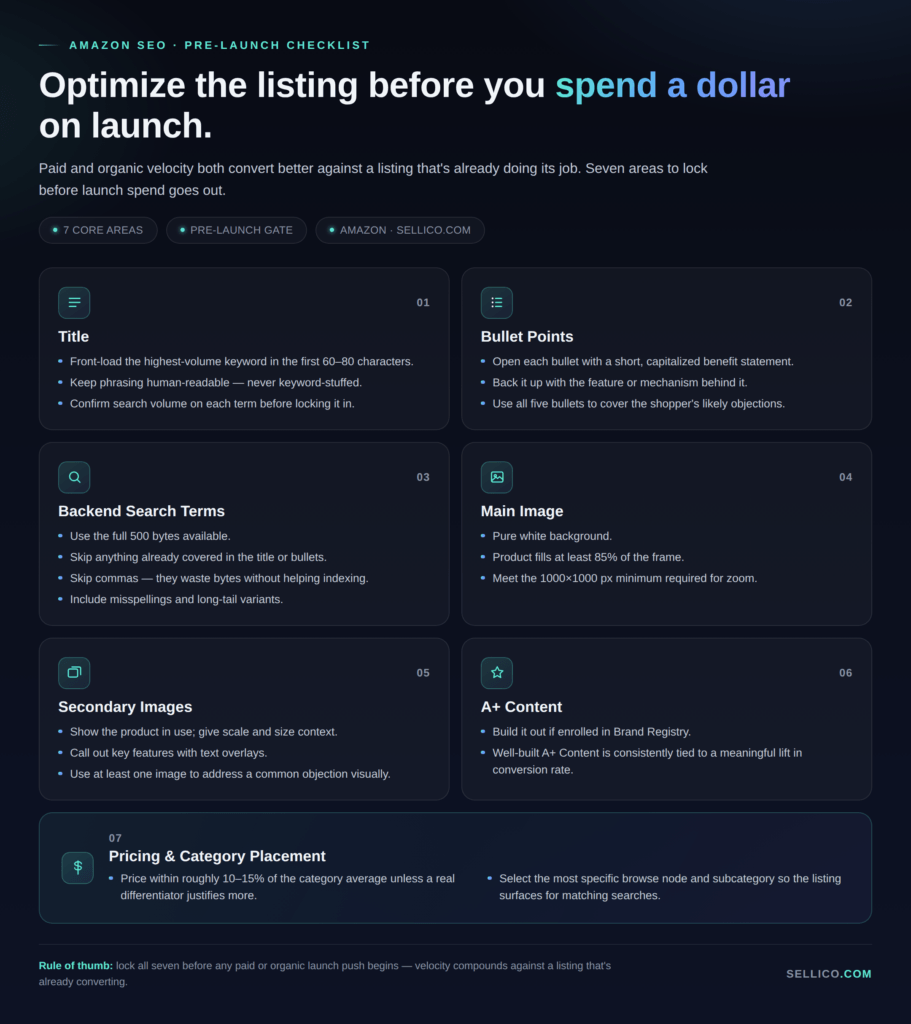
A listing needs to be fully optimized before any launch spend goes out, since paid and organic velocity both convert better against a listing that is already doing its job. These are the seven areas that matter most heading into a launch.
- Title. Front-load the highest-volume keyword in the first 60 to 80 characters, keep the phrasing human-readable rather than stuffed, and confirm search volume on each term before locking it in.
- Bullet points. Open each bullet with a short, capitalized benefit statement, back it up with the feature or mechanism behind it, and use the five bullets collectively to address the purchase objections a shopper is most likely to have.
- Backend search terms. Use the full 500 bytes available, skip anything already covered in the title or bullets, avoid commas since they waste bytes without helping indexing, and include misspellings and long-tail variants.
- Main image. Use a pure white background, fill at least 85% of the frame with the product, and meet the 1000×1000-pixel minimum needed for zoom.
- Secondary images. Show the product in use, give scale and size context, call out key features with text overlays, and use at least one image to address a common objection visually.
- A+ Content. Build it out if enrolled in Brand Registry. Well-built A+ Content is consistently associated with a meaningful lift in conversion rate.
- Pricing and category placement. Price within roughly 10 to 15% of the category average unless a real differentiator justifies more, and select the most specific browse node and subcategory available so the listing surfaces for searches that actually match it.
Launch strategy differences: private-label sellers vs. established brands
A private-label seller launching a first ASIN usually needs the full sequence above, since there is no purchase history, review base, or brand recognition to lean on. An established brand adding a new SKU can often shorten the pre-launch phase and lean more heavily on existing reviews, repeat customers, and brand search volume to accelerate indexing. Both benefit from the same underlying principle: earned organic rank costs less to defend long-term than rank that is entirely rented through ads.
Organic Amazon product launch vs. PPC-driven launch strategy
An organic Amazon product launch strategy builds keyword rank through purchase velocity, listing optimization, and reviews, while a PPC-driven strategy buys visibility directly through Sponsored Products, Sponsored Brands, and Sponsored Display and loses that visibility the moment spend stops.
The two are not mutually exclusive, but they behave very differently over time, and the cost gap is widening. Thirty-two percent of Amazon sellers now cite rising advertising expenses as a top business challenge, based on a survey of nearly 1,500 Amazon sellers (Jungle Scout, State of the Amazon Seller 2025). That is the backdrop against which an organic-first launch approach, like the one built into Sellico’s White-Hat Accelerator, becomes more than a philosophical preference.
| Approach | How it works | Cost pattern | What happens if spend stops |
| PPC-only launch | Sponsored Products/Brands buy top-of-search placement immediately | Ongoing, rises with competition and CPC | Rank drops sharply, since visibility was rented, not earned |
| Organic-first launch (white-hat) | Verified purchases and reviews build keyword indexing and purchase history | Per-unit cost during the campaign window, no ongoing subscription | Rank tends to hold, since it was earned through actual sales history |
| Blended launch | PPC layered on top of an organic foundation for the first 30 to 60 days | Front-loaded, then tapers as organic rank takes over | Rank holds better than PPC-only, since organic groundwork is already in place |
Is it worth paying for a done-for-you Amazon launch and ranking service instead of running PPC yourself?
For most sellers, a done-for-you Amazon product launch and ranking service is worth it when advertising costs are already eating into margin and the seller does not have time to manage a multi-week, multi-channel sequence manually.
Running PPC alone means absorbing rising CPCs with no guarantee of organic carryover once spend stops. Sellico’s White-Hat Accelerator, by comparison, charges $4.00 to $6.50 per unit depending on campaign size, with no setup fees and no subscription, and reimbursement to the shopper is handled within 24 to 48 hours.
Sellers who want a second opinion before committing budget can ask Quantum directly, since it is free and trained on outcomes from actual Sellico campaigns rather than general advice. That combination, a bounded per-unit cost plus a free research layer, is why a growing share of sellers treat organic launch services as a budget line rather than an experiment.
How Amazon Vine, Sponsored Products, and organic keyword ranking work together during a launch
Amazon Vine, Sponsored Products, and organic keyword ranking are not competing tactics. They stack. Vine generates a seller’s first honest reviews from vetted reviewers, Sponsored Products buys visibility for keywords that are not yet ranking organically, and organic rank is the outcome that keeps a listing visible once both Vine allotments and ad budget are exhausted. A launch that uses all three in sequence, reviews first, ads to fill visibility gaps, purchase velocity to earn lasting rank, tends to outperform a launch that leans on only one.
Frequently asked questions
Track ACoS and TACoS to see how efficiently ad spend is converting, organic rank on priority keywords through Search Console-style rank tracking, and review velocity relative to competitors. A launch is working when organic rank climbs even as ACoS trends down, since that signals ads are supplementing earned visibility rather than carrying it entirely.
Most sellers see early keyword indexing within the first one to two weeks and meaningful rank movement by weeks three to four, assuming consistent purchase velocity and ad spend. Full stabilization, where rank holds without heavy ongoing ad support, usually takes six to eight weeks.
No. Vine is one input, not a requirement. Sellers can build a compliant launch using organic purchase programs and Sponsored Products alone, though Vine is often useful for generating a listing’s first reviews quickly when review count is at zero.
The underlying principle, earning velocity and social proof instead of renting all visibility through ads, carries over, but the mechanics differ. TikTok Shop launches involve probation tiers and GMV Max budgets that Amazon does not have, so the week-by-week specifics need adjusting per platform.
Sellico’s White-Hat Accelerator runs $4.00 to $6.50 per unit depending on campaign size, on top of product cost, with no setup fees or subscriptions. Quantum, Sellico’s AI strategist, is free to use for any seller with a dashboard account.
