

Amazon Best Sellers Rank (BSR) is a number Amazon assigns to a product based on its sales volume compared with similar products in the same category. A lower number means a higher rank, so #1 is the top seller. According to Amazon’s own Selling Partner guide to BSR, both recent and all-time sales count, but recent sales count more.
A few details about how Amazon BSR works trip sellers up:
- BSR ignores page views and reviews. Amazon states plainly that neither factor influences Best Sellers Rank.
- One product can have several BSRs. A product earns a separate rank in each category and subcategory it sits in, and the subcategory rank is usually the more useful one to watch.
- Ranks differ by marketplace. A product ranked #1 in the US store can rank much lower in the UK or Japan.
- The Best Seller badge has rules. It goes to products that rank #1 in a category with at least 100 products and meet an order threshold.
What affects Amazon BSR, and what doesn’t
Amazon BSR responds to unit sales and nothing else directly. Everything a seller controls, from price to ads to inventory, only moves BSR by changing how many units sell and how recently they sold.
| Factor | Does it affect BSR? | How |
| Recent unit sales | Yes, directly | The core input; recent sales outweigh older ones |
| Sales consistency over time | Yes | Steady daily sales hold rank better than a single spike |
| Category choice | Yes | BSR is relative to the products in your category |
| Price and promotions | Indirectly | They move BSR only through the extra sales they create |
| Sponsored Products ads | Indirectly | Ad-driven sales count; the ad spend itself does not |
| Stockouts | Yes, negatively | No inventory means no sales, so rank slides |
| Customer reviews | No (not directly) | Amazon excludes them, though they affect conversion |
| Page views | No | Amazon excludes them |
The reviews row settles a common myth. Reviews matter because they change whether shoppers buy, not because Amazon feeds them into the rank.
Amazon BSR vs. organic keyword rank: why they don’t always match
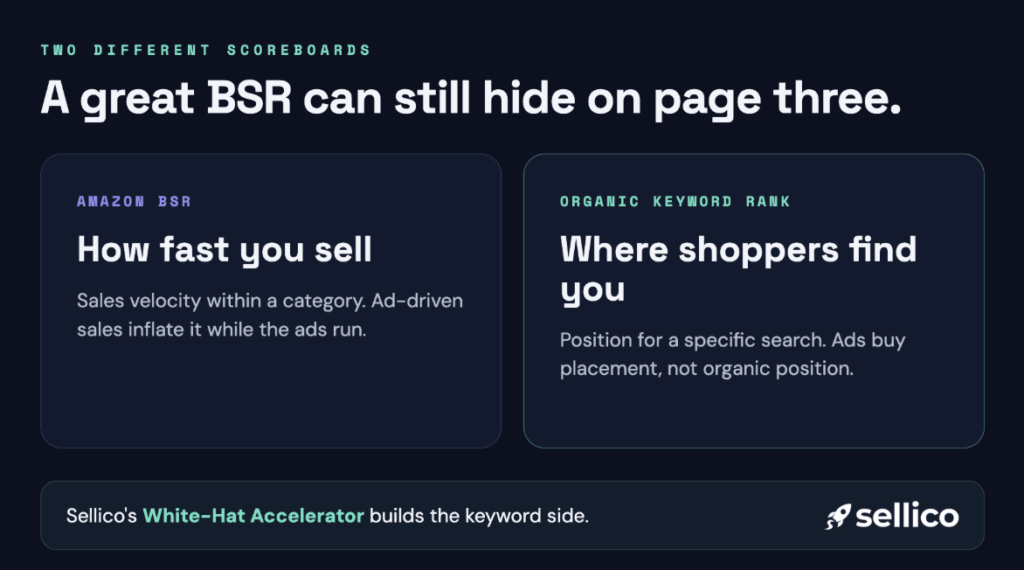
Amazon BSR measures how fast a product sells within a category, while organic keyword rank measures where it appears when a shopper searches a specific phrase. Amazon’s own guide confirms a top BSR doesn’t guarantee a high organic search ranking. That is why a product can hold a strong BSR and still sit on page three for its main keyword.
| Amazon BSR | Organic keyword rank | |
| What it measures | Sales velocity within a category | Position for a specific search term |
| Where it shows | Product detail page, Best Sellers lists | Amazon search results |
| What drives it | Recent unit sales from any source | Relevance, conversion, and sales tied to that keyword |
| Can ads inflate it? | Yes, while the ads run | Ads buy placement, not organic position |
| Why it matters | Signals demand and momentum | Determines whether shoppers find you without ads |
This gap is where Sellico focuses. A product can buy velocity with PPC and still be invisible organically for the searches that matter most. According to Jungle Scout’s State of the Amazon Seller 2025 report, 32% of nearly 1,500 surveyed sellers cite rising advertising costs as a top challenge, which makes ad-only rank expensive to hold.
At Sellico, White-Hat Amazon Accelerator is built for the keyword side of this equation: getting a product indexed and visible for its most important search terms during launch, so sellers aren’t renting every sale from PPC.
Need help mapping your three priority keywords?
How to increase your Amazon sales rank: 7 levers that work
Increasing your Amazon sales rank comes down to selling more units, more consistently, through channels Amazon sanctions. The seven levers below are listed in roughly the order sellers should check them:
- Choose the most specific, accurate category. Amazon calls category selection the first way to improve BSR, since rank is relative to the products around you. Keep parent and child ASINs in the same category.
- Optimize the listing for conversion. Titles, images, bullets, and A+ Content all turn traffic into sales. Amazon’s Manage Your Experiments tool lets brands A/B test titles and images.
- Price competitively and use Amazon’s own promotions. Coupons, deals, and Amazon’s Automate Pricing tool can lift unit sales without off-platform tricks.
- Use Sponsored Products to support velocity, not replace it. Ads accelerate sales, but rank built only on ad spend drops when the budget stops.
- Never run out of stock. A stockout halts sales entirely, and because recent sales weigh most, rank slides fast while you’re empty.
- Build reviews through Amazon Vine. Reviews don’t feed BSR, but Amazon Vine helps new listings earn the trust that lifts conversion.
- Aim for steady daily sales, not spikes. A one-day surge fades quickly as newer sales take over the calculation. Consistent volume holds rank.
Why steady sales beat a one-day spike
Steady sales beat a spike because Amazon weighs recent sales more than older ones, so a burst of orders loses influence within days. A product selling 30 units a day for a month will usually hold its Amazon BSR better than one that sells 900 units on a single promo day and then stalls.
The practical takeaway: plan promotions as steps up to a higher daily baseline, not one-off events. Watch the trend line, not a single day’s number.
Building BSR for a new product launch
A new product launch has no sales history, so its Amazon BSR swings sharply with every order. That volatility is normal. What matters early is pairing sales momentum with keyword indexing, so the product is both selling and findable for the searches that will sustain it.
At Sellico, our team sees launches stall most often when sellers chase rank through ads alone and never establish organic keyword visibility. White-Hat Accelerator campaigns run 30, 60, or 90 days (90 is recommended for launches) and target three strategic keywords with 2,500 to 100,000 monthly searches each.
Why choose Sellico for Amazon launch and keyword strategy
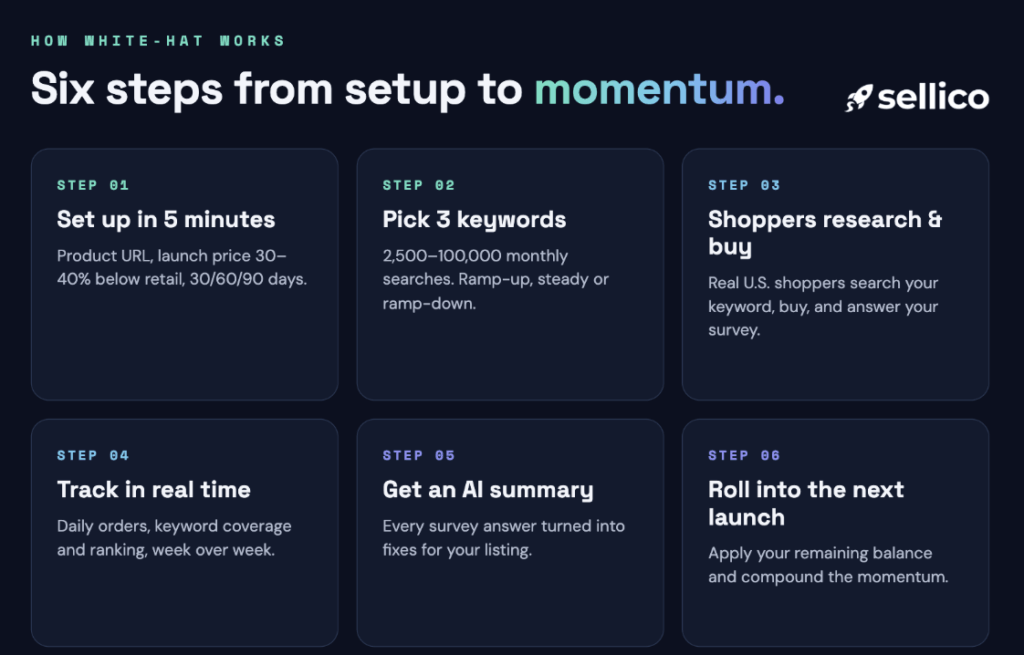
Sellico gives Amazon brands two things most rank guides can’t: an AI strategist trained on real campaign outcomes and a structured launch program with transparent pricing.
- Quantum, Sellico’s AI strategist. Quantum is trained on more than 1,200 completed Sellico campaigns and over 112,000 verified purchases across Amazon and TikTok Shop launches. Sellers can ask plain-language questions, such as “Why is my BSR good but my keyword rank weak?” or “Which three keywords should my launch target?” Quantum is free inside every Sellico dashboard.
- White-Hat Accelerator. Sellico’s Amazon launch program for keyword indexing, with fees of $4.00 to $6.50 per unit, no setup fees, and no monthly subscription.
- Reliable delivery. According to our internal campaign data, 86% of White-Hat campaigns deliver at least 90% of scheduled units.
What is a good Amazon BSR?
A good Amazon BSR depends entirely on the category. A rank of 5,000 can mean strong daily sales in a huge top-level category and weak sales in a small subcategory. The useful benchmark is your rank against the top sellers in your own subcategory.
BSR calculators can estimate monthly sales from a rank, but their numbers are modeled, not Amazon data. Treat them as rough guides and track your own rank trend over weeks.
Is chasing Amazon BSR worth it?
Chasing Amazon BSR is worth it only as a signal, not a goal. BSR measures sales velocity, not profit, so heavy discounting or ad spend can buy a better rank while losing money on every unit.
At Sellico, our team recommends watching BSR alongside organic keyword rank and margin. Rank that holds without heavy discounts is a sign the listing is healthy.
FAQs
No. Amazon states that Best Sellers Rank is not influenced by customer reviews or page views. Reviews still matter, though, because they affect whether shoppers buy, and those extra sales are what move BSR. Programs like Amazon Vine help new listings build early reviews through a channel Amazon runs itself.
Amazon says Best Sellers Rank is updated frequently, and because recent sales are weighted most, rank can shift noticeably within a day. Amazon’s Movers & Shakers lists show the biggest sales rank gains over the past 24 hours. Judge performance by the trend across weeks rather than any single reading.
A product gets a separate Best Sellers Rank for each category and subcategory it belongs to. A tumbler might rank #1 in a narrow subcategory and #2 in a broader kitchen category. The subcategory rank is usually the more meaningful comparison against direct competitors.
PPC improves BSR only indirectly. Sales generated by Sponsored Products ads count toward Best Sellers Rank, but the ad spend itself does not. When ads stop, rank built mostly on ad-driven sales tends to fall, which is why organic keyword visibility matters for holding rank.
No. Amazon’s listing rules bar promotional claims like “best seller” in product titles. The official Best Seller badge is awarded automatically to products ranked #1 in a category of at least 100 products that also meet an order threshold.
Ready to stop renting your rank from PPC? Start a White-Hat Accelerator campaign or ask Quantum what your listing needs first, free, inside the Sellico dashboard.
