

Becoming a TikTok Shop seller in 2026 means clearing a short eligibility check, registering through Seller Center, connecting a payout method, listing your first products, and building enough verified sales to get the algorithm’s attention. Most sellers finish registration in under an hour, though review time and first-sale timelines vary by category and country.
A TikTok Shop seller is anyone registered with TikTok’s Seller Center to sell physical products directly through TikTok videos, livestreams, and the in-app shop tab. That’s a different role from an affiliate, who only promotes other sellers’ products for a commission without holding inventory or a shop of their own.
According to eMarketer, TikTok Shop’s US ecommerce sales are projected to reach $23.41 billion in 2026, a 48% year-over-year increase that would put it ahead of established online retailers like Target, Costco, Best Buy, and Kroger.
Is TikTok Shop still worth it for new sellers in 2026?
Yes, TikTok Shop is still worth it for new sellers in 2026, and the growth numbers back that up. According to Forbes’ reporting, TikTok Shop drove $19 billion in GMV in Q3 2025 alone, nearly matching eBay’s global sales volume for the same quarter.
The same Flywheel Retail Insights data projects ByteDance will rank among the world’s largest retailers by 2030, capturing an estimated 14.6% share of the global marketplace. The channel is maturing fast, which means the sellers who register now are competing against a smaller, less saturated pool than the one that will exist in a year or two.
Eligibility requirements to become a TikTok Shop seller
To become a TikTok Shop seller, you need to be at least 18 years old, provide a valid government-issued ID, register from a supported country, and supply basic business or tax information depending on whether you’re registering as an individual or a company.
The eligibility basics include:
- A valid government-issued photo ID for identity verification.
- Residency or a registered business in a country where TikTok Shop currently operates.
- A bank account or payout method that matches your registered name or business.
- Basic tax information, which varies by whether you register as an individual seller or a business entity.
According to TikTok’s own Seller Center documentation, specific document requirements can shift by country and category, so it’s worth confirming the current list inside Seller Center before you start your application.
How to set up your TikTok Shop seller account: 6 steps
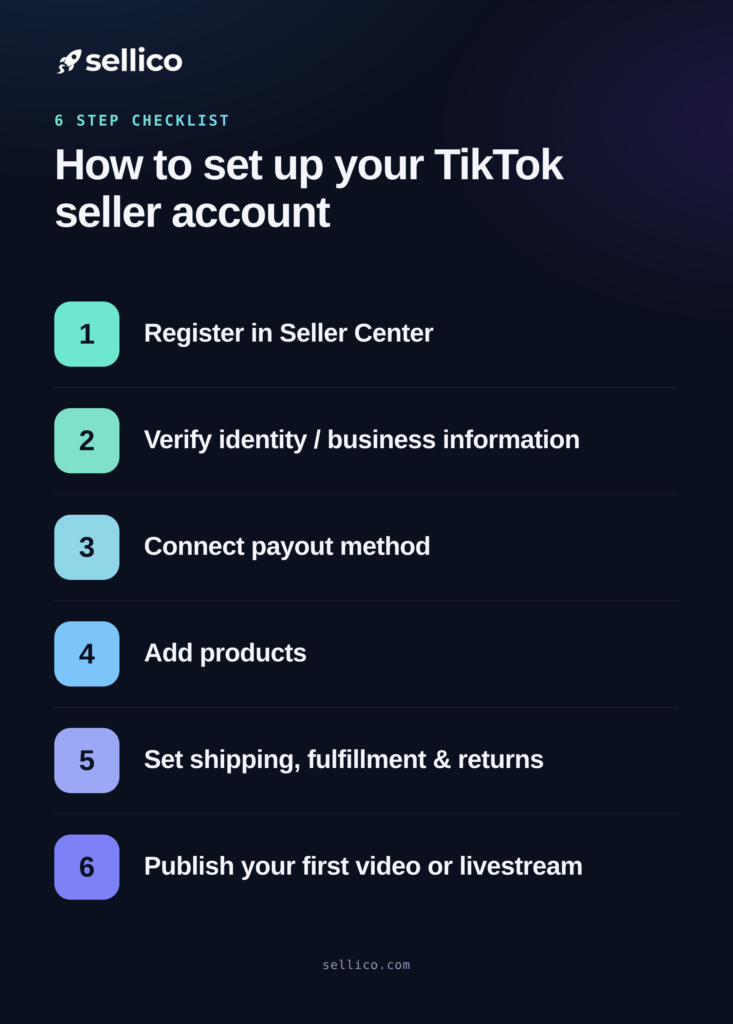
Setting up a TikTok Shop seller account takes six steps, from initial registration to your first published product. TikTok’s Seller Center setup guide walks through the same sequence in more platform-specific detail.
- Register in Seller Center. Create an account with your email or phone number and select your seller type (individual, business, or cross-border).
- Verify your identity and business information. Upload your ID and any required business documents, then wait for TikTok to review your application.
- Connect a payout method. Add a bank account or supported payment method that matches your registered name so payouts don’t get held up.
- List your first products. Add clear titles, accurate categories, real product photos, and honest descriptions, since listing quality affects both search ranking and approval speed.
- Set shipping and fulfillment settings. Choose your shipping rates, processing times, and return policy before your first listing goes live.
- Publish your first shop video or livestream. TikTok Shop sales are driven by content, so your first video or live session is what actually starts putting products in front of buyers.
Do you need followers to become a TikTok Shop seller?
No, you don’t need followers to become a TikTok Shop seller. TikTok Shop’s discovery algorithm surfaces content and products based on engagement and relevance, not existing follower count, which is different from how sales work on most other platforms.
Sellico has seen this play out directly with brand-new accounts. One grooming and hair-loss-treatment brand went from $0 to $250,000 in monthly TikTok Shop revenue in 100 days on a single $16.99 hero SKU, starting with no existing audience at all.
The real blocker for zero-follower sellers isn’t reach, it’s proof. Buyers and TikTok’s own algorithm both favor listings with verified purchases and reviews behind them, which is why a compliant early sales push matters more than follower count in the first weeks after launch.
This is where Sellico’s Launchpad comes in. Launchpad helps new or stalled TikTok Shop sellers build momentum by generating verified purchases, increasing GMV and Shop Performance Score, unlocking affiliate outreach, and encouraging compliant reviews. Sellers fund a campaign, while Sellico coordinates purchases through its shopper network, reimburses shoppers, and tracks the campaign and results in real time.
Which TikTok Shop seller type is right for you?
TikTok Shop supports three seller types: merchant sellers, affiliate sellers, and dropshippers, and the right one depends on whether you want to hold inventory and build a standalone brand.
| Seller type | What it is | Inventory required? | Best for |
| Merchant seller | Owns the product listing, brand, and fulfillment | Yes | Sellers building a standalone brand or product line |
| Affiliate seller | Promotes other sellers’ products for a commission | No | Creators who want to earn from content without holding stock |
| Dropshipper | Lists products fulfilled by a third-party supplier | No (supplier holds it) | Sellers who want low upfront inventory risk |
Merchant sellers get the most control over pricing, branding, and customer experience, but also carry the most responsibility for fulfillment and product quality metrics. That’s the seller type Sellico’s Launchpad campaigns are built to support, since a compliant, review-driven launch matters most when your own brand and Shop Performance Score are on the line.
TikTok Shop seller vs. Amazon seller: which is easier to start in 2026?
Starting as a TikTok Shop seller is generally faster and less crowded than starting as an Amazon seller in 2026, mainly because TikTok Shop’s content-driven discovery doesn’t require competing directly against thousands of near-identical listings in a search results page.
Amazon still wins on raw buyer intent, since shoppers arrive already searching to buy. TikTok Shop instead relies on video and livestream content to create demand from scratch, which means a new seller’s success depends more on content quality and consistency than on winning a keyword search.
Both platforms charge category-based commissions and require verified business or tax information. If fees are the deciding factor for you, see the fee breakdown below before you register on either one.
TikTok Shop seller fees explained
TikTok Shop charges sellers a per-category referral commission on each completed sale, plus standard payment processing costs, similar in structure to most marketplace platforms. Exact rates vary by product category and can change, so they should always be confirmed inside your Seller Center dashboard before you price a listing.
Because fee schedules update periodically, treat any percentage you see as a starting reference point, not a final number. Seller Center displays your current, category-specific rate before you publish.
Real results from TikTok Shop sellers Sellico has helped launch
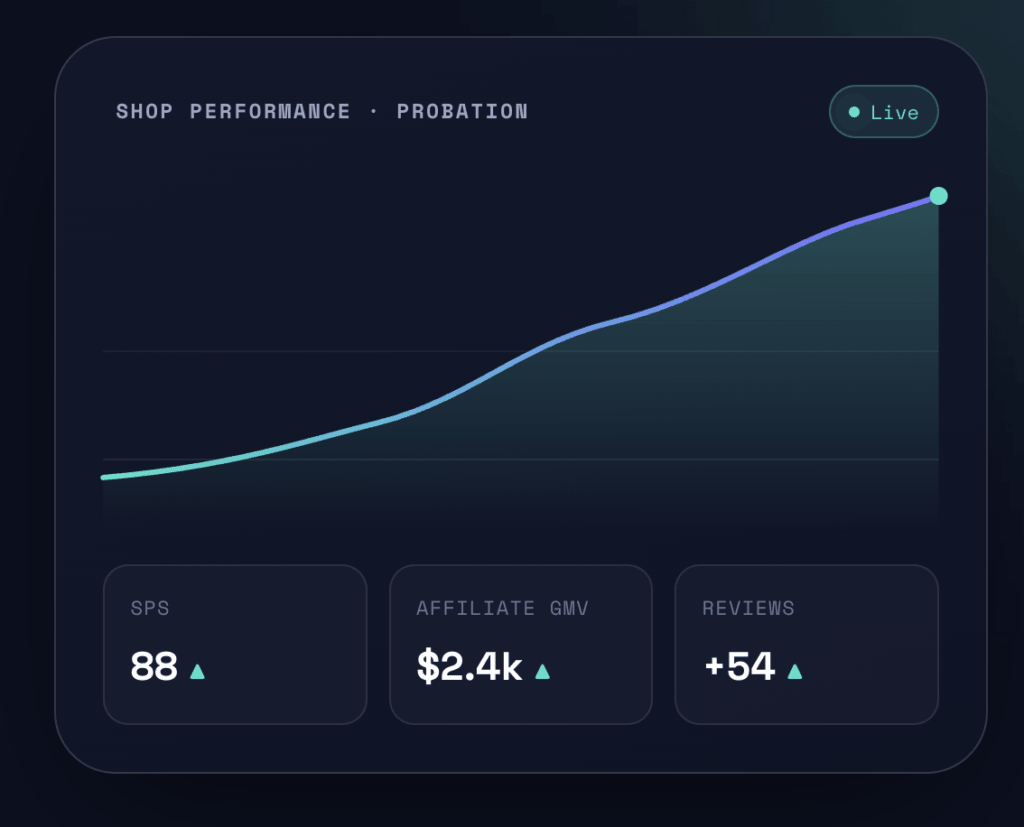
Real numbers, not hype: across 1,229 completed Sellico campaigns from October 2025 to July 2026, the median campaign delivers 100% of scheduled units, and 78% deliver at least 90%.
Typical shapes look like this: Launchpad (TikTok) runs about 51 units over 10 days, White-Hat (Amazon) about 100 units over 13 days, and Marketplace Ranking (ecommerce marketplaces) about 100 units over 30 days. Voluntary review rate can be 20%-40%, paced to stay FTC-compliant.
Restricted and prohibited product categories to know before you launch
Most restricted or prohibited categories on TikTok Shop overlap with what you’d expect from any major ecommerce marketplace. Common examples include alcohol and tobacco products, weapons and hazardous materials, prescription drugs, counterfeit or trademark-infringing goods, and adult content.
Because restricted category lists get updated as TikTok Shop’s policies evolve, confirm the current list inside Seller Center before you finalize a product line, especially if you’re entering a regulated category like supplements or beauty.
FAQs
A TikTok Shop seller is anyone registered through TikTok’s Seller Center to sell physical products directly through TikTok content, livestreams, and the in-app shop tab. That’s distinct from an affiliate, who promotes other sellers’ listings for commission without holding a shop of their own.
TikTok generally reviews new seller applications within a few business days, though timelines vary by country, category, and how complete your submitted documents are. First-sale timing depends more on content and review history than approval speed alone, so check your application status directly in Seller Center.
Not necessarily. TikTok Shop supports both individual and business seller registration, and individual sellers can typically register with personal identification and tax information rather than a formal business license, depending on their country’s requirements.
Yes. Affiliate sellers and dropshippers can both sell on TikTok Shop without holding their own inventory, either by earning commission promoting other sellers’ products or by listing items a third-party supplier fulfills directly.
Ready to launch as a merchant seller without starting from zero reviews? Start a Launchpad campaign or ask Sellico’s Quantum what your shop needs first, free, inside the Sellico dashboard.
